Success Story
The service desk that only looked automated.
A global pharmaceutical company closes the last mile of service desk automation and saves more than $1M a year.

A global pharmaceutical company closes the last mile of service desk automation and saves more than $1M a year.
On paper, the service desk was automated. Tickets for new hires, role changes, password resets, and departures were created automatically, and leadership reasonably believed the process ran itself.
The tickets did not resolve themselves. Behind the queue sat teams of people who opened each ticket, worked out what it was asking for, and then carried out the steps by hand across the systems involved. A large share of that work was identity work: provisioning, role changes, password resets, and offboarding.
The result was a process that was fast at the front and slow at the back. Every ticket still waited for a person, and every manual step was a chance for a delay or an error.
The company used READI to automate the back half of the process. When an identity-related ticket is created, READI reads what it asks for and carries out the remediation in the target systems: creating the account, changing the role, resetting the password, or removing access.
The ticket is the trigger and the record. The work in between no longer depends on someone being available to pick it up.
learn more
 Success Story
 Video
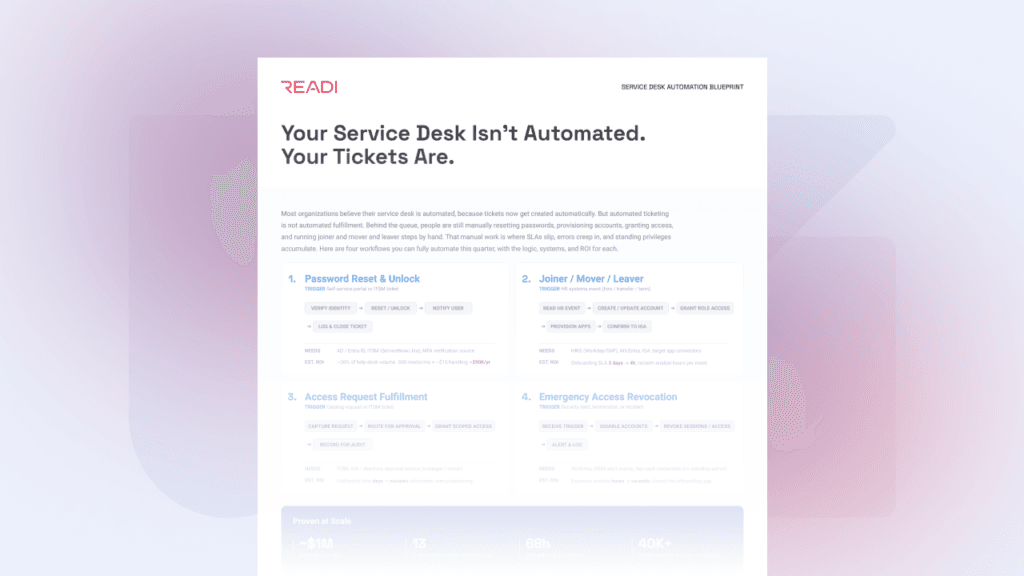 One Pager
ten minutes, no sales call.
Key takeaway
A Fortune 100 pharmaceutical company automated ticket creation but still required manual resolution of identity tasks. READI automated the back-end by executing identity remediation directly from service desk tickets, eliminating manual steps and delivering over $1M in annual savings while freeing staff for higher-value work.
Suggested questions